Picture the two extremes of content: a phone held above a crowd, and a cinema rig ready to capture the perfect hero shot. Most brand conversations pretend you have to choose one. This shouldn’t be the initial way of framing something as dynamic as content. It isn’t a choice between two lengths, it’s a portfolio of formats, each one engineered for a specific audience, a distinct platform, and a particular moment of intent. What we’ll come to terms with in this blog is whether short and long-form content are interchangeable, or if businesses need to begin leveraging the value of both
– simultaneously.

So the strategic question isn’t “which one should we use?” — it’s “how do these fit together into a system that compounds?” Moving away from treating content formats as separate, competing choices is the only direction worth heading in 2026.
Short-form video marketing and strategy: why brands are leaning in
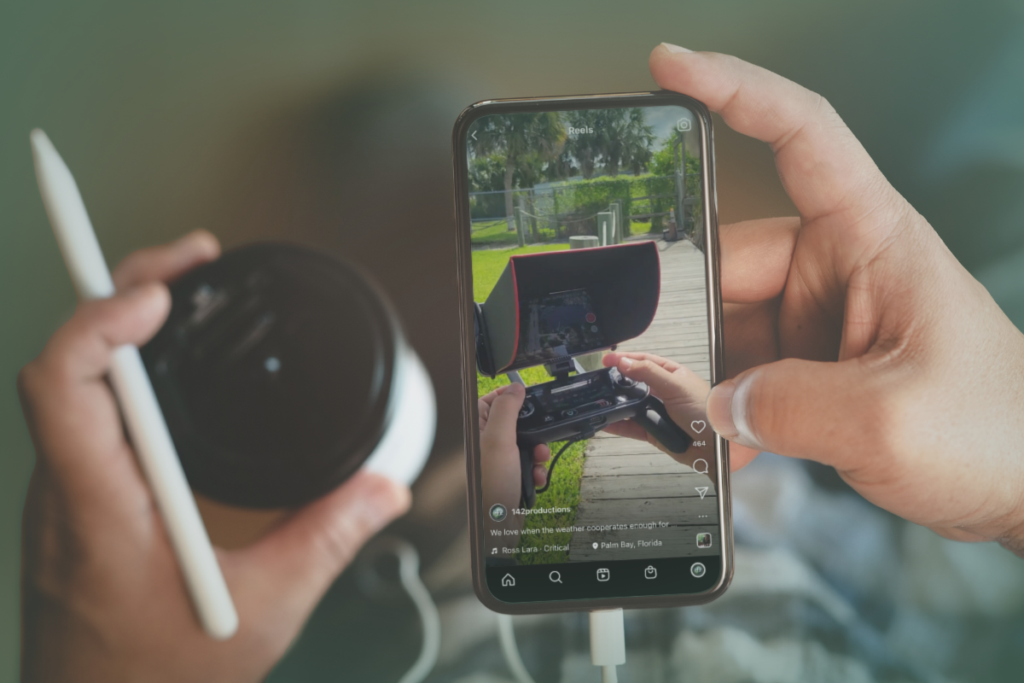
To build a successful brand, businesses must view content as a portfolio of formats where short-form serves as the high-velocity engine designed to fuel a larger, more durable narrative (we’ll touch on durability later on).
Brands lean into short-form formats like TikTok, Reels, and Shorts because they are the most efficient reach mechanisms available. Their primary function is to interrupt the scroll, not to build trust or brand character.
How short-form content matches modern viewing habits
Short-form is perfectly aligned with the “quick-scan” habits of moving, distracted audiences who want to absorb information in under a second. This is because in the buyer’s journey, short-form content excels at the awareness stage. It acts as a top-level informative “hook” that helps potential customers contextualise a problem before they are ready for a deeper solution. – graph of a ‘buyers journey’ sits here
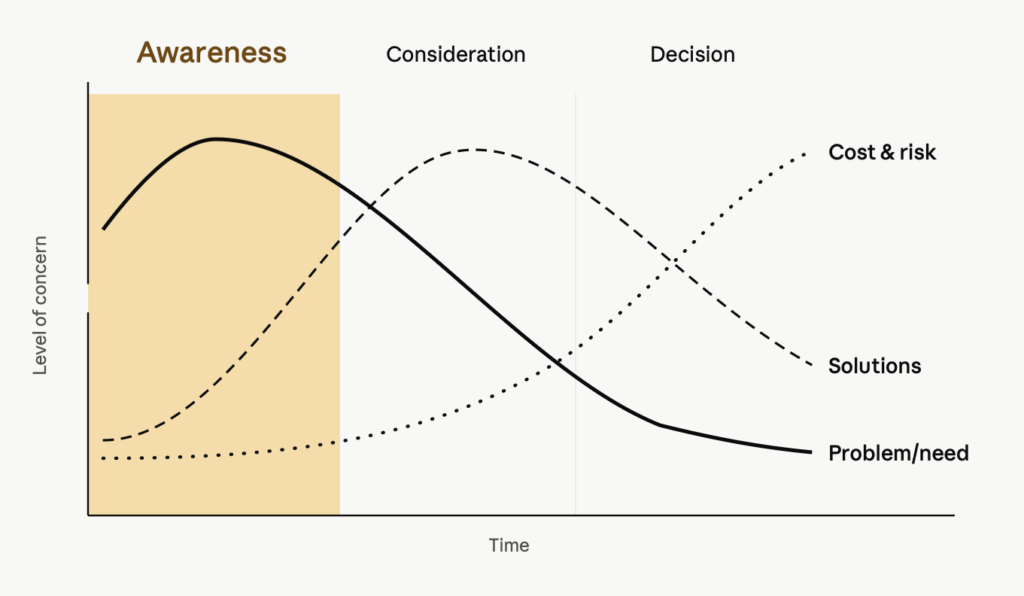
Look at where the solid “problem/need” curve peaks — right at the start, inside the awareness band. That’s the moment a buyer first feels a problem but hasn’t yet gone looking for a solution. Their concern isn’t “which product should I buy?” — it’s “wait, is this even a thing I should be worried about?”. The cost and risk curves are still flat on the floor at this point; those questions haven’t occurred to them yet.
This is exactly the gap short-form content is built to fill. A 15-second Reel, a quick TikTok, a single scroll-stopping graphic — none of these can close a sale, and they aren’t meant to. What they do brilliantly is meet a person at that first spike of concern and give it a shape.
Meeting people at the right moment
Short-form video—particularly when driven by athletes or creators—commands significantly higher engagement rates (averaging 5.6% compared to 2.4% for general influencers) and can generate a high return on ad spend.
Take Inter-Miami and their record breaking engagement levels since signing Leonel Messi. A pattern that’s become abundantly clear is that people follow people, not badges. Inter Miami went from 1 million followers in early June of 2023 to over 7 million in a matter of days— a fairly blunt reminder that individual narrative beats team loyalty. although short-form is where that pull gets converted in real time, lets look at where the value actually settles.
Athlete storytelling in sports marketing
There’s no mistaking it, short-form content has it’s place in new-age consumer habits – but when we look at athletes, particularly in 2026, what we see are story-tellers.

Value settles when athletes step into long-form: Brooks Koepka letting the cameras see him at his most exposed in the glowing Netflix series Full Swing, or the character arcs that make Drive to Survive work as drama rather than sport. That’s the stuff that turns a casual scroller into someone who knows the storylines, picks a side, and comes back next season.
The difference is participation. When athletes are creators in their own story rather than subjects of someone else’s, audiences get something they’ve become very good at detecting the absence of: proof. Not a claim about who someone is, but a look at it. That’s what a fleeting interaction becomes something more durable — and it’s why the follower spike is the start of the story, not the end of it.
You’ll tend to find that storytelling principles travel far beyond obvious sports heroes. None of what we’ve discussed so far needs a Netflix budget or a household name. The principle underneath it — that people trust what they can watch happen — travels much further than elite sport. We proved that on the Indy Autonomous Challenge, a docufilm for a race series where there is no driver in the car at all. The competitors are university engineering teams, and the cars run themselves. On paper, there’s no athlete to follow. So we went and found the people anyway.
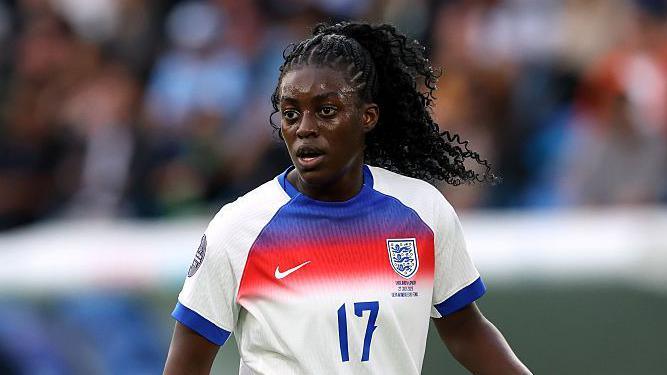
Engagement with women’s sports content is growing at 17.8% per year, nearly double the 9% growth rate of men’s sports. What is most interesting about this growth is that 72% of engagement is driven by individual athletes rather than teams or leagues – this is exactly how story telling works. There are no coincidences to this strategy. What we’re witnessing is a rise in human trust – not simply brand trust.
Short-Form as the Gateway to Long-Form
While short-form is vital for visibility, strategic value can only truly be unlocked when it functions as the acquisition channel that routes viewers toward deeper, long-form work.
If only roughly 5% of an audience is ready to buy at any given time, short-form provides a low-friction way to maintain a pulse but long-form content builds relationships with the other 95% during their long incubation period.
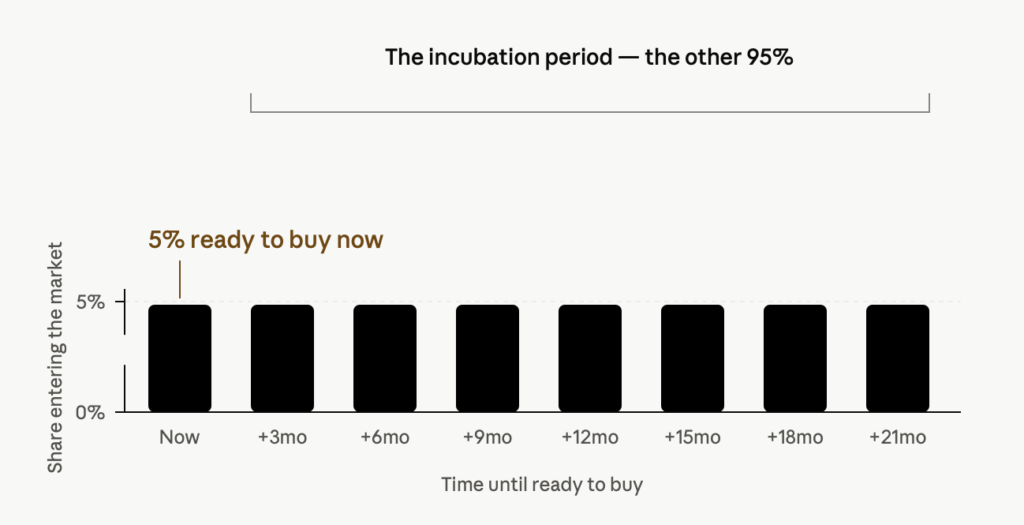
Most businesses burn their entire budget chasing that 5% with hard-sell ads. The smarter move is to court the other 95%. You’re not closing a sale so much as managing a long incubation period — and short-form is the ideal tool for that warming-up phase. It keeps you top of mind, so that when someone finally crosses from the 95% into the 5%, you’re the option they’ve already spent months getting to know.
In this system, short-form is the perishable asset—it is fast and effective but its relevance often decays within days. In contrast, long-form or documentary-style content is the brand loyalty. Brands like Red Bull and Formula 1 use short-form clips not as standalone products, but as “trailers” for the narrative arcs found in their documentary series and films.
Top-tier branding doesn’t abandon one for the other
In practice, that looks like a few different plays:
- The behind-the-scenes B-roll reel : Showing the unpolished reality of a shoot to humanise the brand.
- The educational hook : Short, sharp videos that answer one burning FAQ or hand over a single pro tip to lift visibility and interest.
- The branded challenge : Leaning into a trend or a question to prompt genuine interaction, rather than delivering a formal pitch.
Content-strategy mapping
To dodge the “awareness trap” — plenty of views, zero commitments — a modern strategy needs to run across three distinct tiers.
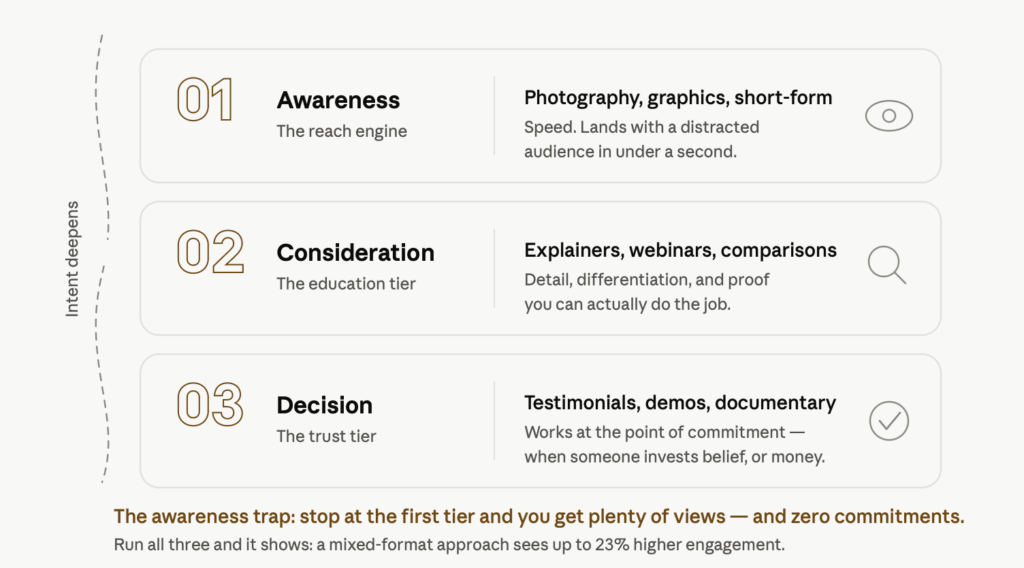
The mistake is treating these as interchangeable. A brand producing only hype clips earns the look but never the signature. A brand producing only long documentaries may have a masterpiece nobody ever finds. Do both well and it shows: brands using a mixed-format approach see up to 23% higher engagement rates.
The truth about brand-retention
If short-form is about discovery, documentary-style content is about retention. A TikTok clip’s relevance can decay in days. A well-made brand film stays a working asset for months, sometimes years.
This is where intimate branding actually lives. Documentary storytelling swaps persuasion for observation. By showing real environments, unscripted conversations, and genuine human effort, a brand reads as more transparent and more trustworthy. In a market where audiences are deeply sceptical of anything too polished, showing the messy middle of a project — or the raw grind of an athlete — becomes a genuine differentiator.

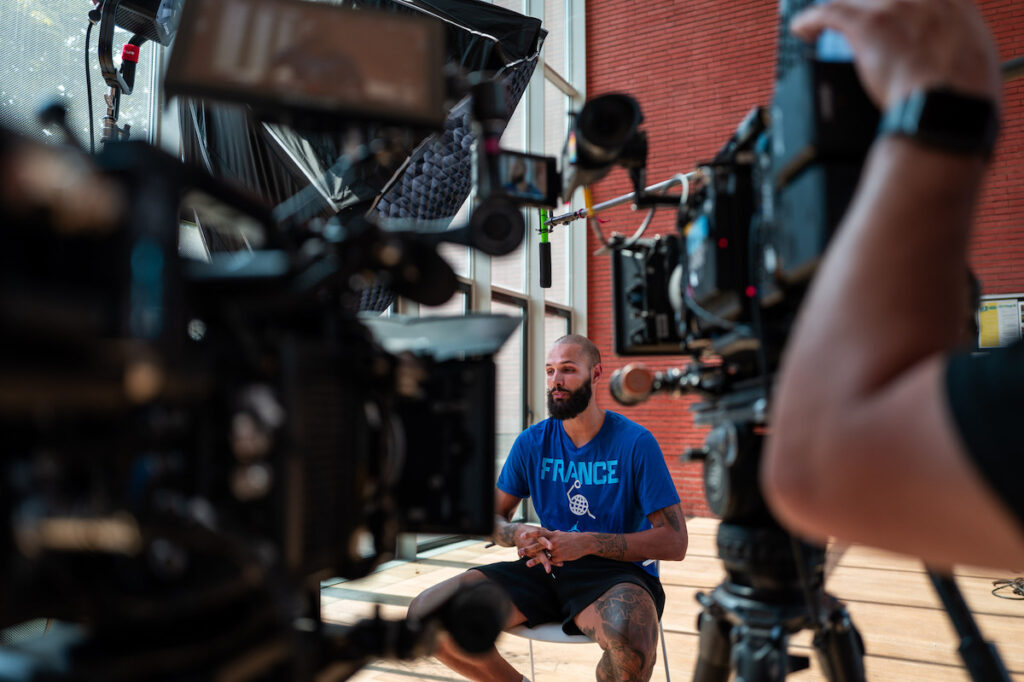
There’s a tactical edge on top of the emotional one. Doc-style work functions as the source material for everything else. A single high-quality shoot doesn’t just yield a hero film. It generates:
- a hero film for the website
- mid-funnel cutdowns for LinkedIn
- a library of high-impact stills for graphics
- dozens of short-form scroll-stoppers for Reels and Shorts
One production feeds the entire toolkit. The short-form pieces drive the traffic; the hero asset holds the durable value that traffic is supposed to build toward.
Lessons from the heavyweights: Red Bull and F1
Red Bull evolved from a drinks manufacturer into a global media powerhouse by treating content as owned infrastructure that appreciates, not an expense that gets consumed. That approach helped build a brand valued at excess of $20 billion — one that creates culture rather than just buying ad space inside it.
This is not to say Red Bull have abandoned short-form, they still use short-form content across all of their platforms. However, such brand loyalty could have never been earned through years of short-form content.
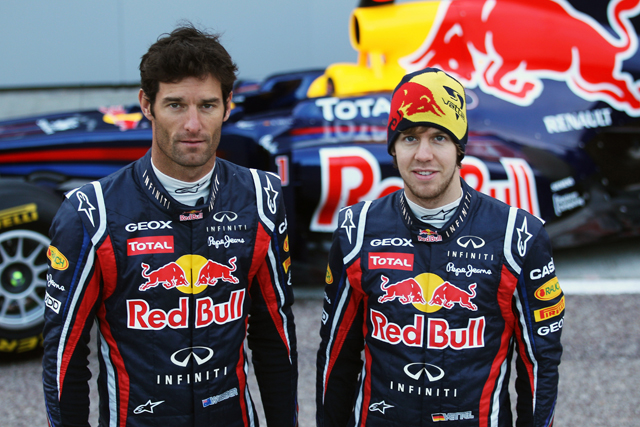
Netflix’s Drive to Survive makes the same point from a different angle. It proved long-form narrative could reshape a sport’s entire commercial position. It didn’t just show the racing; it showed the characters, the contract negotiations, the pressure on team principals. That doc-style treatment turned casual viewers into informed fans who followed the season’s storylines — and the payoff was a massive expansion of F1’s US audience, plus a blueprint since replicated in golf (Full Swing) and tennis (Break Point).
Invest in the source
The real marketing advantage in 2026 isn’t choosing between a 15-second Reel and a 15-minute documentary. It’s understanding that they’re two sides of the same coin.
Short-form is your acquisition channel: fast, reactive, and essential for capturing the 26% of sponsorship value that individual athletes now drive on social. It’s how you rent attention in a crowded market.
Documentary-style content is your brand loyalty. It’s how you own that attention by turning it into trust — humanising the brand, communicating purpose through real-world action, and generating the raw material that fuels your entire digital presence.
Measured over a week, a viral TikTok will often look like the bigger win than a brand film. But measured over years — the timescale on which real intimacy and brand legacy are built — documentary-style storytelling is the superior investment. It’s the one format that leaves a narrative legacy standing long after the scroll has moved on.
Invest in the source.